



 19 / 24

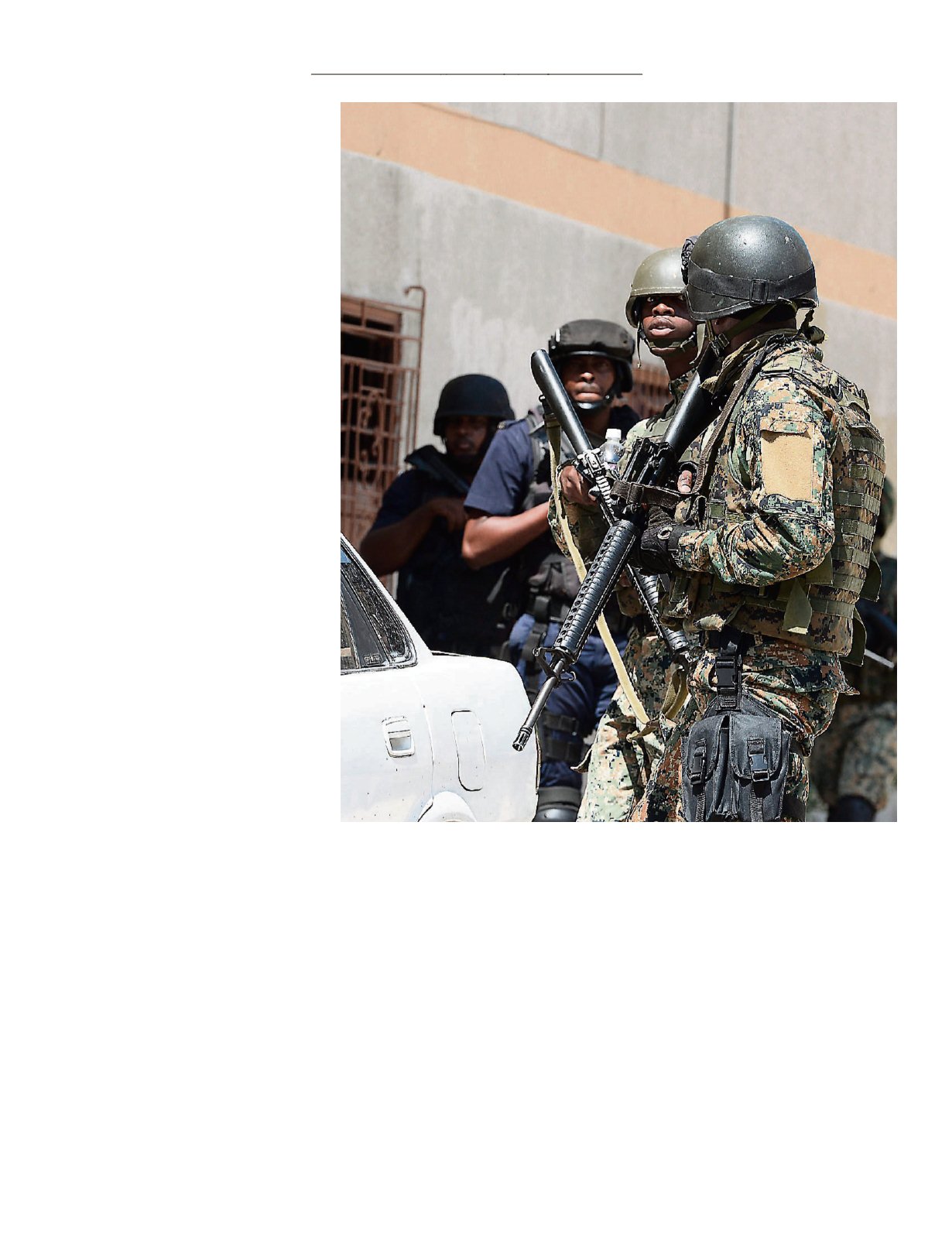
Part of the danger that police officers face
rests in the structure and original purpose of
the Jamaica Constabulary Force (JCF) that
many in the society are slow to change.
From the Victorian period to the present,
the British used the police as the most visi-
ble symbol of colonial rule. The structure
has been a blending of military and civilian
roles into one police service. With the
establishment of the Metropolitan Police in
London in 1829 came a shift from military-
to community-style policing as the primary
way of dealing with social order. The many
police forces formed in the colonies in the
19th century were not allowed to model the
New Police in England.
In the late 1990s, the JCF started to make
an obvious shift away from reactive, para-
military responses to crime and disorder and
began to openly embrace community-based
policing. Nonetheless, there has not been
enough of a culture shift within or outside
the JCF to significantly reduce the depend-
ence on deadly force.
Every country has a measured policing
efficacy; and usually, this is by conviction
and/or clear-up rates. In this article, we
examine the relationship between the clear-
up rate and murder rate between 1960 and
2007 for Jamaica. It is fair to expect a coun-
try to clear up at least 50 per cent of its mur-
ders. However, this is not always possible in
certain unstable environments. The data
allow us to make three conclusions that are
comparable with trends in other high-vio-
lence Caribbean countries such as Trinidad
and Belize.
First, there is an almost mirror-perfect
inverse relationship between clear-up and
murder rates – as murders increase in num-
bers, the capacity (especially if unchanged
in tooling and operation) to clear up murders
falls with comparable velocity.
STRUGGLE TO CLEAR UP MURDERS
Second, most security forces struggle to
achieve even the base clear-up rate of 50
per cent once the murder rate exceeds the
civil-war benchmark of 30 per 100,000.
The dataset shows that just before
Independence, the homicide rate was below
five per 100,000, comparable with the
world’s average; and hence the country had
a clear-up rate above 95 per cent.
Independence usually comes with unrealis-
tic demands from the populace and politi-
cal struggles to seize leadership. Our tran-
sition was problematic; we quickly became
segmentary factional – Comrades versus
Labourites. Within 10 years of
Independence, our murder rate jumped
beyond 10 per 100,000 and the clear-up
rate dropped dramatically below 70 per
cent. Nonetheless, up until the political
tribal war of 1976-1980, national security
was able to achieve at least the minimum
50 per cent clear-up rate.
In 1976, Jamaica’s homicide rate was 20
per 100,000 with a clear-up rate of 62 per
cent. The following year, the homicide rate
climbed slightly to 22 per 100,000 and the
clear-up rate slipped to 52 per cent. In the
middle year (1978), homicide stabilised
somewhat at 21 per 100,000, and the clear-
up rate climbed back correspondingly to 54
per cent.
The following year (1979) can be
described as the calm before the storm.
Homicide dropped to 19 per 100,000 as
political activists and party-aligned gangs
watched and planned for the upcoming elec-
tion. Then came the ‘War of 1980’ in which
over 800 Jamaicans murdered each other,
resulting a homicide rate of 48 per 100,000.
As we jumped across the civil-war bench-
mark, the clear-up rate took a dive to an
embarrassing 37 per cent. The shock of our
tribal war, and the absence of a competitive
general election for a decade rescued our
social sanity. However, by 1995, we had
again crossed the civil war benchmark, and
only for single exceptional years (1999 and
2003) have the clear-up rates exceeded 50
per cent.
The Jamaica
Constabulary Force
is dependent on
deadly force
PUBLISHED: FEBRUARY 1, 2017