



 22 / 24

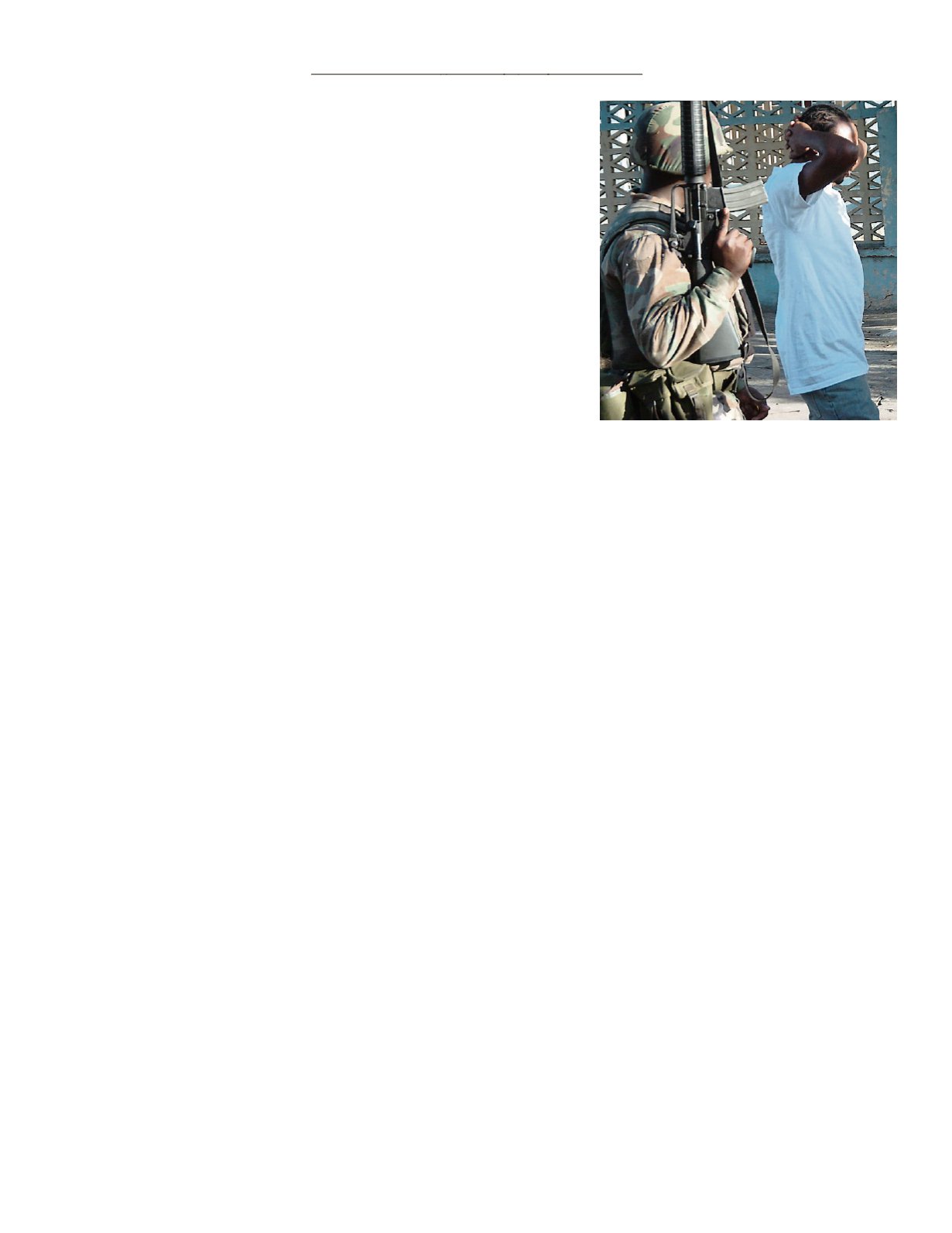
Here are four core challenges:
1
Though certain, violence reduction
is slow. In fact, we know a country
is on this path when murders are con-
sistently reduced by small margins such
as one to five per cent each year such
as in Honduras and Colombia. Violence
reduction is not good for Jamaican
politicians and die-hard Labourites and
Comrades who want things to happen
fast before the next general election.
2
It does not fit well into our culture
of “We want justice now!” “We
want results now, a long time we a
suffa!” This means that it will not auto-
matically get public support, especially
since people will be dying while we
embark on this journey to reduce vio-
lence. The best handle to use to sell vio-
lence reduction is logic: since the sup-
pression has failed so miserably, let us
try something new. This would, howev-
er, require serious social marketing.
3
It requires major investments in
research, and the ownership cannot
be singular. This means that the private
sector would have to invest heavily in
the reduction of violence and wait for
five-10 years to reap the benefits.
Nonetheless, current figures show that
violence directly wipes out four per
cent of GDP, and between two and 17
per cent of businesses, depending on
the size and type. Hence, it is prudent
for the private sector to treat violence
reduction as an investment. Belize’s
private sector, government, and interna-
tional donors invested about
US$200,000 in the Male Social
Participation and Violence Study
(Gayle 2016). Today, they have materi-
al to use to embark on their journey of
reduction. It would cost Jamaica only
US$500,000 to carry out a similar vio-
lence audit across the country over five
years – and it is now urgent.
4
Reduction strategies focus on the
actors, and in so doing, help to
reduce the number of victims. This
will require a major paradigm shift as
we love victims (having being vic-
timised for centuries). Note, though,
that no young person who perpetrates
violence is only an actor – they are
also victims of structural and direct
violence. By now, we have all come
to recognise that humans transfer vio-
lence: males oppress younger, smaller,
or weaker males, who find smaller
and economically vulnerable females
to oppress; these battered women are
the most likely to abuse children; and
these children are the most likely to
bully smaller or isolated children.
This is why experts rescue both the
bullied and the bully – not rescue the
victim and expel the bully to go to
another school to carry on the act.
A reduction strategy requires us to
address the root causes of our violence.
It is based on the observation that vio-
lence is a bi-product of our social ills.
In other words, if we fix the social ills
that directly affect violence, the prob-
lem will automatically wither away.
Suppression addresses the symptoms of
our problems and makes politicians,
victims, and some citizens enjoy a
quick fix like crack addicts. In fact, the
longer we take to address the root caus-
es, the deeper we sink into our addic-
tion of suppression and the more vio-
lent we become. Some of us are already
addicted to suppression. On several
occasions, citizens have been videoed,
shouting: “Shoot him nuh, squaddie!”
Reducing youth violence is more complex
than suppressing it.
VIOLENCE-REDUCTION STRATEGIES
ARE NOT POPULAR, BUT NECESSARY
So why do we have an average homi-
cide rate of 48 per 100,000 since the year
2000? Why was our homicide rate for
2016 an alarming 50 per 100,000 (six
times higher than the world’s average),
despite all the police aggression and
fancy gang strategies? We already know
that our crisis of gang violence and
organised crime comes from a complex
causal flow of factors. However, I shall
remind you:
Our history of slavery and colonialism
created two major crises in Jamaica:
• Segmentary factional (violent) politics,
and
• Eroded families (absent fathers, espe-
cially in inner cities, causing at-risk mothers
to torture boys, with disastrous results);
Segmentary factional politics always cre-
ates weak central political authority as it
takes teamwork to develop a stable country;
The weak central political authority over-
burdens the police and overexposes them
to violence;
War-ready police clash with the unloved,
unsupported, and sometimes tortured young
men, who are also at war with each other.
There are broad
reduction projects that
need to be done in the
medium to long run
(five-20 years):
Change the ecology
or environment that
breeds violence –
increase the welfare
net through PATH
rather than MPs;
address sanitation
needs of crisis fami-
lies; address the
needs of ‘on the
street’ and ‘of the
street children’; and
dramatically reduce
the trafficking of
girls.
Reduce social exclu-
sion of youth (male
and female) –
apprenticeship, men-
torship for all inner-
city and rural poor
youth.
Ensure that all inner-
city children are
attending school full
time – not only girls
– and thus reduce the
power of gangs to
mobilise.
Encourage educated
women to continue
reducing the reliance
of politicians on
violence to win
elections.
Speed up the process
of modernising the
JCF.
VIOLENCE REDUCTION
IN THE LONG TERM
WHY ARE WE STILL STRUGGLING TO CONTAIN VIOLENCE?
PUBLISHED: FEBRUARY 2, 2017