



 20 / 24

POLITICS AND DRUGS
Third, homicide rates
usually jump beyond 30
per 100,000 whenever
there is structured mobili-
sation of inner-city youth.
In the case of Jamaica, this
implies politics and drug
trafficking – and hence,
both are to blame for the
country’s failure to achieve
a clear-up rate of 50 per
cent. Murders soared in
the 1990s and peaked in
2005 at 64 per 100,000
because of the meticulous-
ly crafted symbiotic rela-
tionship that developed
between politics and drug-
trafficking gangs. The
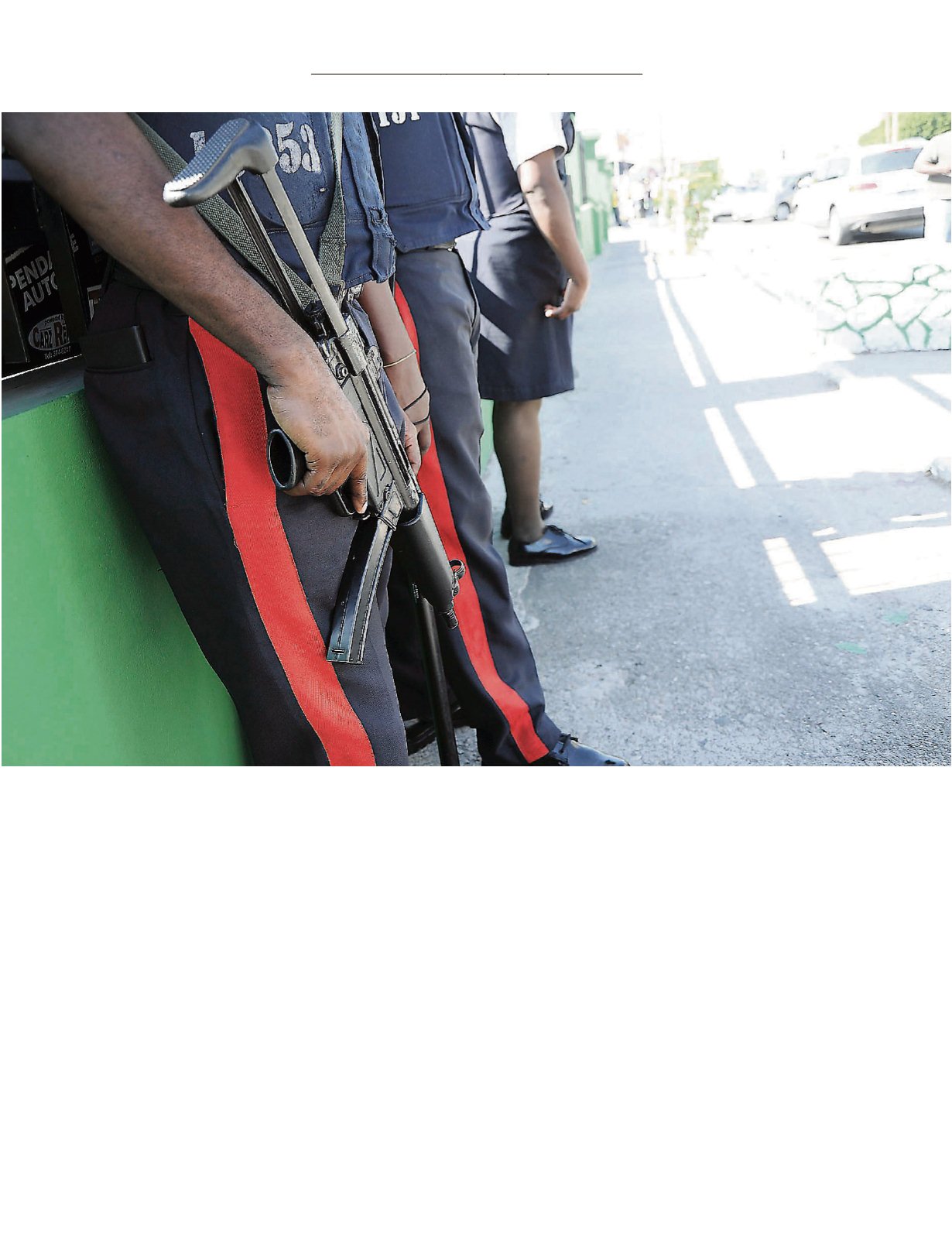
State then relies on para-
military policing to
address one side of the
relationship – the combat-
ant youth.
It is obvious that para-
military policing is not
effective in reducing vio-
lence in Jamaica; yet we
do not have the climate
or cultural acceptance for
community policing. In
fact, community policing
in Jamaica has been qui-
etly rejected as being
feminine by many police
officers and society on
the whole. Many persons
in community policing
are given no public
recognition as this is not
seen as policing. Add the
country’s sharp social
divisions to the fact that
we accept policing to be
paramilitary, and the
problem becomes clear.
Human beings often
rationalise violence
against those who are
‘other’.
‘CLASSIST’ SOCIETY
There are many
Jamaicans – from policy-
makers to middle class to
rural folk to inner-city
dwellers – who support
the police and youth
killing each other. We
ascribe a value to the
lives of both inner city
youth and frontline
police, both of whom are
unfortunately from the
underclass. We do not
say it, but we know that
the police come from the
poorest homes.
Jamaicans are extremely
‘classist’. We treat the
death of anyone from the
merchant class as a
catastrophe, but the death
of a peasant with indif-
ference.
The society has created
what is known as struc-
tural violence against
garrison youth and front-
line police officers. None
can expect to get justice
or social support. The
logic is therefore clear
that they must, by
design, kill each other.
Again and again, year by
year, the police will kill
the youth, and they, too,
will justify killing the
police – and this feud
between them will con-
tinue to maintain a politi-
cal economy of violence
in Jamaica. Police deaths
(and the correspondent
deaths of youth by the
police) are tied to the
degree of violence in the
society – but even more
important is the factor of
acceptance by the society
of the death of ‘others’,
or those with whom we
do not identify.
While we continue to
encourage community or
service-oriented policing,
we, too, must begin the
social change to reduce
social exclusion.
PUBLISHED: FEBRUARY 1, 2017