



 11 / 24

3
Political divisions created a
weak central political author-
ity, and hence perpetual problems
in governance, making successive
governments weak on legitimacy
that is needed for consensual
power and the legitimate use of
force. Feuds thrive in settings
where there is a weak central
political authority (Black-
Michaud, 1975). The central polit-
ical authority includes the legisla-
ture, judiciary, security forces, and
civil society (media and faith-
based groups included). While the
discussion may seem to focus on
the face of the state (security
forces), it is understood that with-
out effective legislature (parlia-
ment), and visible justice output
from the courts (judiciary), as well
as endorsements of state power
and policies by civil society, the
work of the security forces cannot
effectively reduce the murder rate,
especially after it surpasses 30 per
100,000. Policing efficacy is the
most visible and easily measured
aspect of the composite; but it is
also an indicator of the state of the
entire central political authority.
In order to govern, an adminis-
tration must be able to get the com-
pliance of its citizens. One of the
most effective ways of controlling
people is to take advantage of their
fear of violence. This implies that
governments must show some
police and military might. Having
developed the capacity of violence,
governments have a second and
greater challenge: legitimacy. The
government of a group is consid-
ered legitimate when the members
or its public believe – on the basis
of experience – that the govern-
ment will produce decisions that
are in accord with the public’s
interest. It is easy to mobilise the
urban poor to violently block the
path of governance in Jamaica
because our governments have
been weak on legitimacy – they do
not seem to act in the interest of
the public. The four-day shutdown
of the country to protest against the
government’s policy to hike the
price of petrol in 1999 is a good
example. Many Jamaicans do not
identify with the ‘ruling clan’, they
identify with their political party,
their community and other discrete
groups.
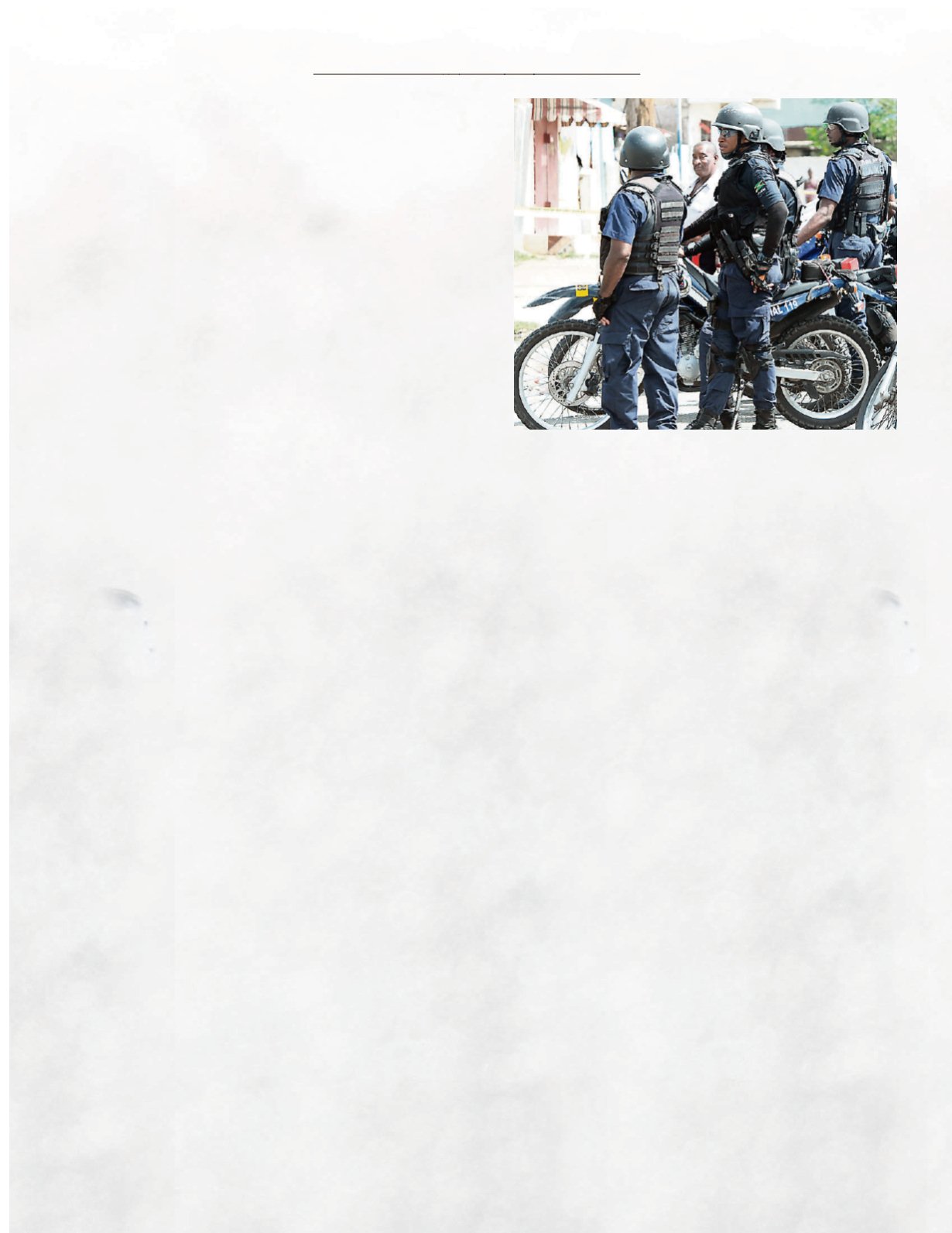
FILE
Police at a crime scene along Spanish Town Road last
October. Fear factor within the police force contributes
to the maintenance of our two sets of wars: one
between gangs and another between State agents and
gangs, says Herbert Gayle.
PUBLISHED: JANUARY 26, 2017
‘Our governments have been
weak. They do not seem to
act in public interest’
Inner-city fathers
missing from homes
4
Jamaican gangs are fed
by problems within the
family created by slavery, and
the cultural acceptance of the
effectiveness of violence,
including the torture of inner-
city boys as part of socialisa-
tion and control. Caribbean
scholars have largely agreed
that the practices of slavery
eroded the role of men as
fathers; and this has impacted
the social stability of coun-
tries such as Jamaica. The
National Census (2011) and
Survey of Living Conditions
(2012) provide data to show
that over two-fifths (41 per
cent) of Jamaicans of early-
childhood age have their bio-
logical fathers in their house-
holds; and over a quarter of
other children have active
extra-residential fathers.
However, father presence
varies based on socio-eco-
nomic setting. In stable social
settings, almost three-quarters
of children are likely to have
quality interactions with their
fathers; but in the inner city,
less than a third have a father
in their homes – and less than
a half have active fathers.
Tortured boys quickest to live
on streets or join gangs
5
Missing fathers (dead, in
prison, abroad, those suspi-
cious of being ‘jacketed’, or the
irresponsible) create yet another
problem if the mother has no
extended family to support rais-
ing the boy. We describe these
mothers as at-risk. These moth-
ers have been found in several
studies to torture their sons (beat
unconscious, tie in ants nest, uri-
nate on them, burn them with hot
clothes iron, poison them) in
order to control them.
In the past 22 years, I have
studied over 200 repeat killers;
and the easiest way to know if a
killer was tortured by his mother
is to find out if he felt numb
towards the victim at the first
kill, and/or if he finds it easy to
rape. According to Bowlby
(1951), the connection between
mother and son is the strongest
attachment among humans. Boys
severely abused by their mothers
can trigger immense feelings of
rejection and hatred for people
overall, especially women.
Repeat killers account for over
50 per cent of Jamaica’s mur-
ders. Tortured boys also drive up
domestic violence; and are the
quickest to live on the streets or
join gangs.
War-readiness mode
6
The environment created by our civil
war-level violence makes policing a very fear-washed
area of work. Fear factor within the police force contributes to
the maintenance of our two sets of wars: one between gangs
and another between State agents and gangs. The police here
are 50 times more likely to be killed than those in developed
countries such as England or New Zealand. Jamaica’s homi-
cide rate keeps security officers in necessary war-readiness
mode – and this mode keeps the cycle of violence going in the
inner cities.