



 6 / 24

Herbert Gayle
Contributor
J
AMAICA IS in obvious
transition. During such peri-
ods, there are imbalances
between state power and consen-
sus, needs and available
resources, and political ambi-
tions and citizens’ wishes, result-
ing in unwanted chaos, which
denies people safety or feeling of
safety.
No country can transition
without basic social order. Small
countries such as Jamaica have
very little external physical
threats – but they often harm
themselves, or retard their
development from within. Since
the 1980s, Jamaica’s obvious
internal threat has come from
social violence. At the surface of
this problem is direct physical
violence. This form is the most
feared and studied because it is
visible, graphic and destructive.
Nonetheless, it is often the
result of structural violence that is
created by a country’s history or
culture that includes the legitimi-
sation of structural and direct vio-
lence, and institutional violence
that allows those with authority to
harm selected groups of the peo-
ple they are supposed to protect.
The core problem for Jamaica
is that social violence retards the
engines of development, includ-
ing education, training, business
and governance. Without heavy
investments in education and
training, countries can remain in
transition for a prolonged period;
and the longer a country remains
in this chaotic phase the more dif-
ficult it is to achieve the quality
governance needed to facilitate
business or the economy. Not
surprising, countries with high
levels of homicide have major
development and governance
problems. So crippling is social
violence that it was estimated in
2006 that if the Caribbean
reduced its homicide rate by a
third, its income per capita could
have doubled (United Nations
Office on Drugs and Crime,
2006).
EATING INTO
EDUCATION BUDGET
The economic cost of social vio-
lence taken as a unit of analysis
shows the dramatic impact of the
problem. Injuries, seen in Jamaica’s
five chief hospitals in 2008,
accounted for 12 per cent of the
budget of the Ministry of Health
(Ministry of Health, 2009). The
budget of the Ministry of Education
could have been increased substan-
tially (up to US$30 per student per
annum) if so much money was not
being spent addressing violence-
related injuries. This would reduce
the high cost of education, which is
one of Jamaica’s major inhibitors to
socio-economic stability. There is a
direct relationship between educa-
tion and violence. Countries with
low levels of education usually
have high levels of homicide
(United Nations Office on Drugs
and Crime, 2006). World Bank
Business Victimization Survey of
400 firms (2003) suggested that
Jamaica is an expensive place to do
business due to its high violence
rate.
Health care and loss of pro-
duction – 3.7% of GDP.
Private expenditure on
security – 2% overall but
17% of
microenterprises.
Extortion, fraud, robbery, bur-
glary, arson – 2% of large
companies, and 9% SMEs.
UNWANTED CHAOS VERSUS SAFETY
FILE
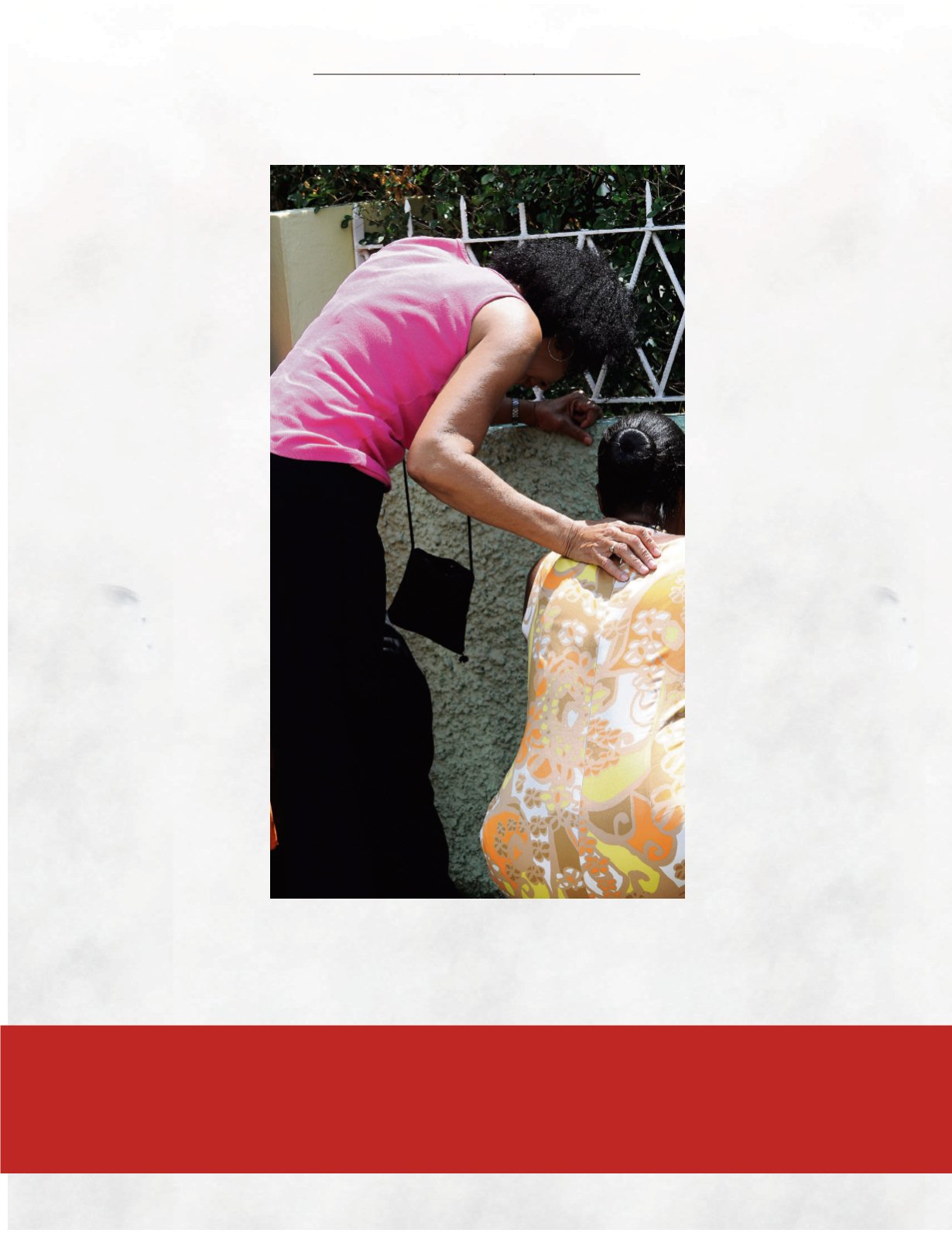
As news spread of the killing of retired Assistant
Superintendent of Police Denzil Boyd, members of his
church visit the the crime scene near his home in
Queensborough Gardens in 2013. Boyd was shot and killed
at his gate by gunmen as he returned from church.
Garrisons were constructed in order for politicians to
guarantee votes, and the youth quickly organised
themselves into gangs to effect war to benefit from the
spoils of war and partisan contracts.
PUBLISHED: JANUARY 25, 2017