



 8 / 24

T
O UNDER-
STAND the seri-
ousness of the
homicide problem among
the combatant age of the
male population of our
inner-city communities,
we shall compare these
figures with Iraq at full-
scale war. A 2013 study
(Mortality in Iraq
Associated with the
2003–2011 War and
Occupation: Findings
from a National Cluster
Sample Survey by the
University Collaborative
Iraq Mortality Study)
calculated that there were
about 461,000 war-relat-
ed deaths in Iraq during
the US-led invasion of
2003 to 2011. This
means an average yearly
death of 57,625. Using
the estimated average
population of 28.17 mil-
lion for the period, we
can calculate that the
war-related homicide rate
was 205 per 100,000.
Notice that at 405 per
100,000 for combatant
aged males in the KMR,
the death rate was almost
twice higher than that of
Iraq at
full-scale war.
The figures show that
Jamaica has an ‘unde-
clared civil war’ between
gangs, and between
gangs and the State. The
data over the last 16
years show devastating
results from these wars –
a kind of social suicide.
Basically, we are killing
ourselves. Let us now
examine the side of the
State. Between 1989 and
1999, the police death
rate was 112 per
100,000. This increased
to 154 per 100,000
between 2000 and 2010
before the ‘Tivoli
Incursion’. These figures
are among the worst in
the world and show that
the State is taking a
heavy toll. In countries
such as New Zealand, the
police homicide rate is a
mere three per 100,000 –
that is 51 times less than
for the Jamaican police.
In New Zealand and
Europe, police can con-
centrate on community-
style policing; in
Jamaica, the police
remain in war-readiness
mode – and emotionally
hold on to the protective
frame of paramilitary
policing. This style of
policing continues to
feed the anger in the
inner cities, which helps
to fuel gang formation.
However, no one in
charge of the police dare
say put your weapons
away when the officers
are so washed with fear.
Major changes must
come at some point, and
come soon.
(See Figure
2)
CAUSES OF HIGH
MURDER RATE
Since the start of the
new millennium, Jamaica
has had the fourth high-
est average murders in
the world. This is the
result of centuries of
oppression, combined
with decades of political
warring. In the work of
violence experts, a histo-
ry of violence is of criti-
cal importance to the
construction and mainte-
nance of feud or inces-
sant warring.
Anthropologists of social
violence are usually con-
cerned with two broad
sets of impact caused by
a history of violence:
adaptation to violent
ecologies, and socialisa-
tion and social organisa-
tion around the effective-
ness of violence.
The ability of the
human species to adapt
to environments is well
documented; but the
work of Dawkins (1976)
is critical to our under-
standing here of how
aggression is critically
necessary for our sur-
vival, and how each
group of persons pass on
the variant gene that has
the greatest advantage
for survival in a specific
environment, including
violent ones. In other
words, the efficacy of
violence is now in our
genes. We know how to
use it to achieve political
and economic ends, and
even to end domestic dis-
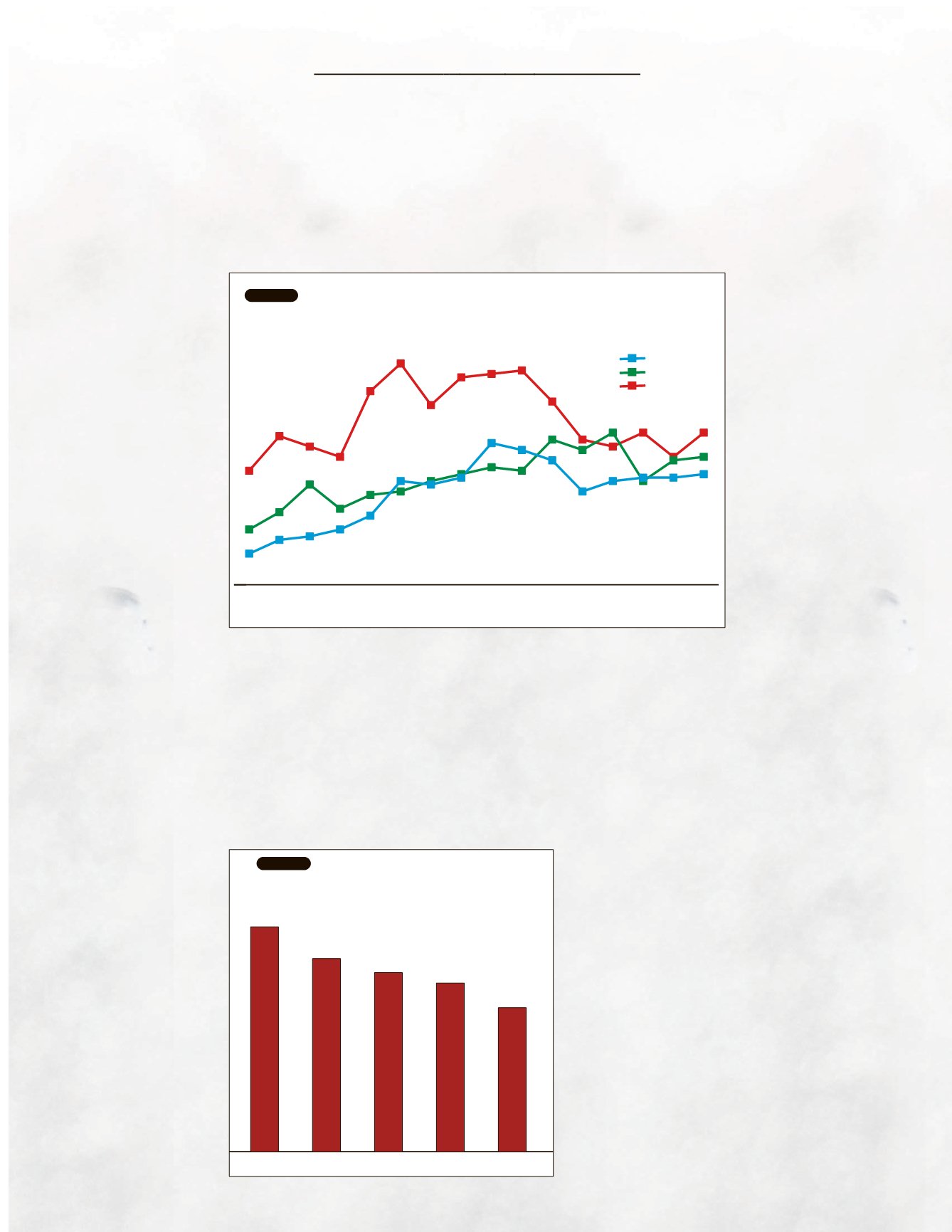
putes. The figures below
(Figure 3) show that
while the Tivoli
Incursion had done much
to restore some power in
the state’s apparatus,
murders have simply
been fluctuating.
Violence is a by-product
of social ills. In Jamaica,
we have many, ranging
from social injustice to
exclusion from basic
education. There is
urgent need for the
trained, the brave and
policymakers to sit down
to discuss the way for-
ward.
Honduras El Salvador Venezuela Jamaica Colombia
64
55
51
48
41
Top-five countries with highest average murder
rates since year 2000
FIGURE 2
9
16
33
43
40
37
56
64
52
60 61 62
53
42
39
44
37
44
21
29
22
26
27
30
32
34 33
42
39
44
30
36
37
13 14
16
20
30
29
31
41
39
36
27
30
31
31 32
2000 2001 2002 2003 2004 2005 2006 2007 2008 2009 2010 2011 2012 2013 2014 2015
Murder trends in Jamaica, Trinidad and Belize 2000-2015
Trinidad
Belize
Jamaica
FIGURE 3
‘WE ARE KILLING OURSELVES
IN UNDECLARED CIVIL WAR’
PUBLISHED: JANUARY 25, 2017