



 10 / 24

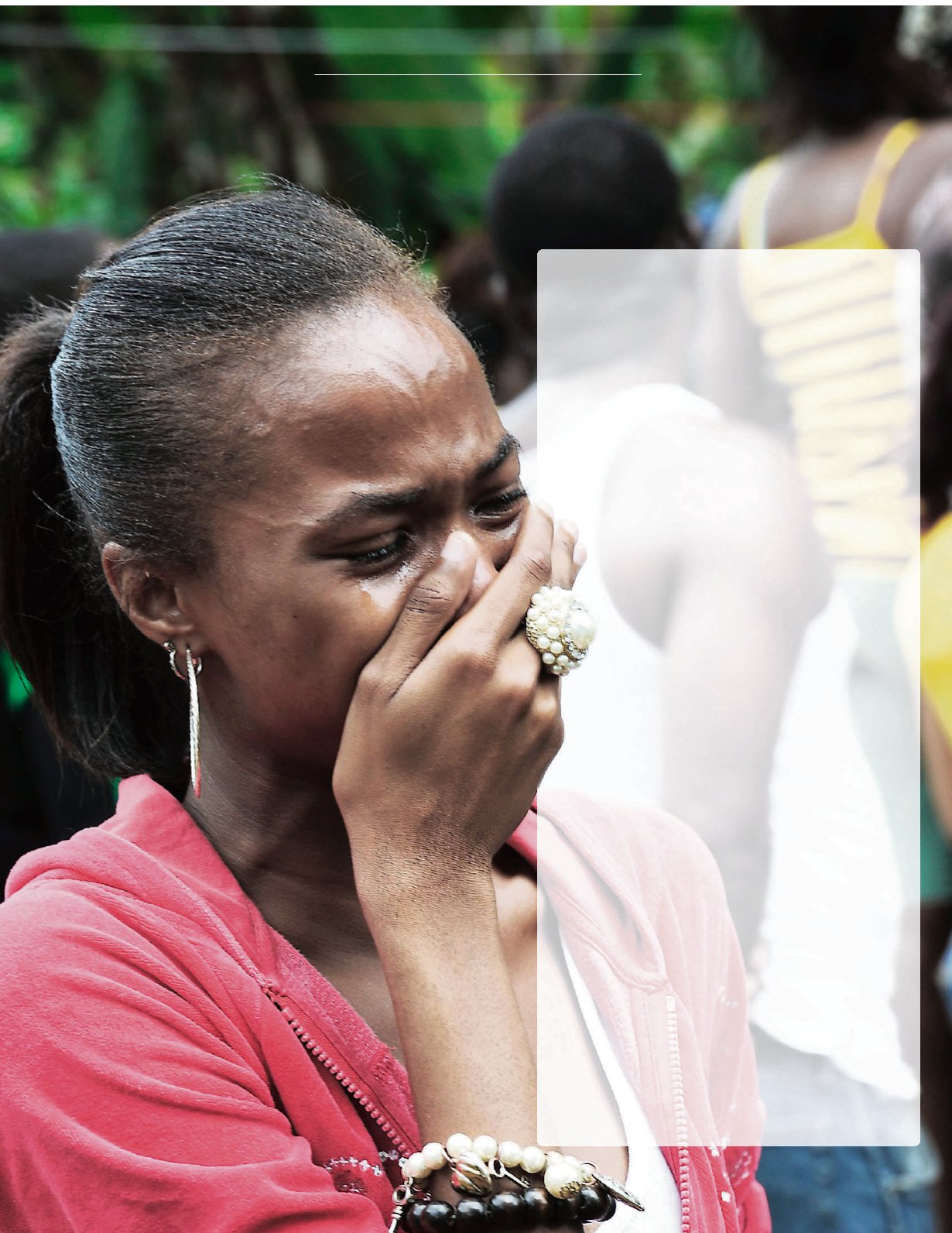
A relative overcome with
emotion at a crime scene.
Transition created a
power crisis in Jamaica
2
Jamaica’s segmentary factional politics which sur-
faced in the 1970s was rooted in our knowledge of
the effectiveness of violence. Slavery also damaged our
family structures. After more than three centuries of
slavery and colonial domination, Jamaica gained
Independence from Britain. This transition created a
power crisis. When power crises develop, sooner or
later the political field becomes an ‘arena’ in which the
contenders are arrayed in two camps or factions.
According to Nicolas (
Segmentary Factional
Political Systems
, 1966), in settings of rapid
social change – be it independence or attempts
at democratisation – factions emerge or become
more clearly defined because the setting allows
for increased competition. Based on degree and
quality of political manipulation, factions may
become the dominant form of political organisa-
tion for the purpose of securing votes. When
universal adult suffrage elections were intro-
duced in rural India, factional organisation proved
to be the most effective way of bringing in votes. In
Jamaica, politicians constructed ‘garrisons’ to secure
the votes they mobilised.
ELECTORAL MIGHT
About a third of all the inner-city communities of the
Kingston Metropolitan Region (KMR) are garrisons to
varying degrees, and they guarantee the member of par-
liament repeat victories. A garrison community is usual-
ly created by the development of large-scale housing
schemes, where houses are allocated to supporters of
the political party in power; and the homogenisation by
the dominant party activists push out the minority and
guard against invasion from outside.
A hard-core garrison community exhibits an element
of autonomy; it is a state within a state. In such commu-
nities, disputes are settled, matters tried and offenders
sentenced and punished without reference to the
Jamaican State. The Jamaican State has no authority or
power except in so far as its police and military forces
are able to invade to enforce order, which can prove dis-
astrous (Ministry of National Security, 1997). Inner
cities make up a mere eight per cent of Jamaica’s popu-
lation; but they have enough power to decide the results
of a general election for the other 92 per cent.
PUBLISHED: JANUARY 26, 2017