



 9 / 24

Herbert Gayle
Contributor
T
HE PRIMARY problems related to social vio-
lence in Jamaica are gangs, organised crime, and
domestic conflict. Jamaica suffers immensely
from the feuds that are created from these interrelated
structures of violence. While there are many frames of
explanation for our problem, focus here will be on six
planks of contributing factors.
History of Violence
(Slavery)
Segmentary
Factional Politics
Gang Violence
and Organized
Crime
Torture
of
Boys
Fear Factor within the JCF
Weak
Central Political
Authority
Domestic
Violence
Absent Fathers
and Unsupported
Single Mothers
Human species has relied on
violence to establish boundaries
1
Jamaica has a well-documented
history of violence. This is of criti-
cal importance to the construction and
maintenance of feud or continuous
warring. Anthropologists of social vio-
lence are usually concerned with two
broad sets of impact caused by a histo-
ry of violence: adaptation to violent
environments, and socialisation and
social organisation around the effec-
tiveness of violence. The ability of the
human species to adapt to environ-
ments is well documented; but the
work of Dawkins (
Selfish Gene
, 1976)
is critical to our understanding here of
how aggression is critically necessary
for our survival, and how each group
of persons pass on the variant gene that
has the greatest advantage for survival
in a specific environment, including
violent ones. In other words, we pass
on the gene to effect war – in order to
survive in violent settings.
Throughout history, the human
species has relied on violence to
establish boundaries and for necessary
predation. Hunting is a primal chemi-
cal act and is built on the need to sur-
vive. Yet violence goes beyond imme-
diate survival. Humans are always
concerned about survival in the medi-
um and long run. When gangs or any
group attack others, it is not always
about an immediate goal, but for the
future. For instance, a physical threat
from a group cannot be taken lightly
by males because once beaten it
encourages the victor to repeat the act.
Retaliation is prudent. Mothers and
other socialisation agents will always
teach the males of a battered group to
be aggressive. People who are
oppressed or preyed on usually organ-
ise their lives around the violence that
is used against them with the aim to
become the victors one day.
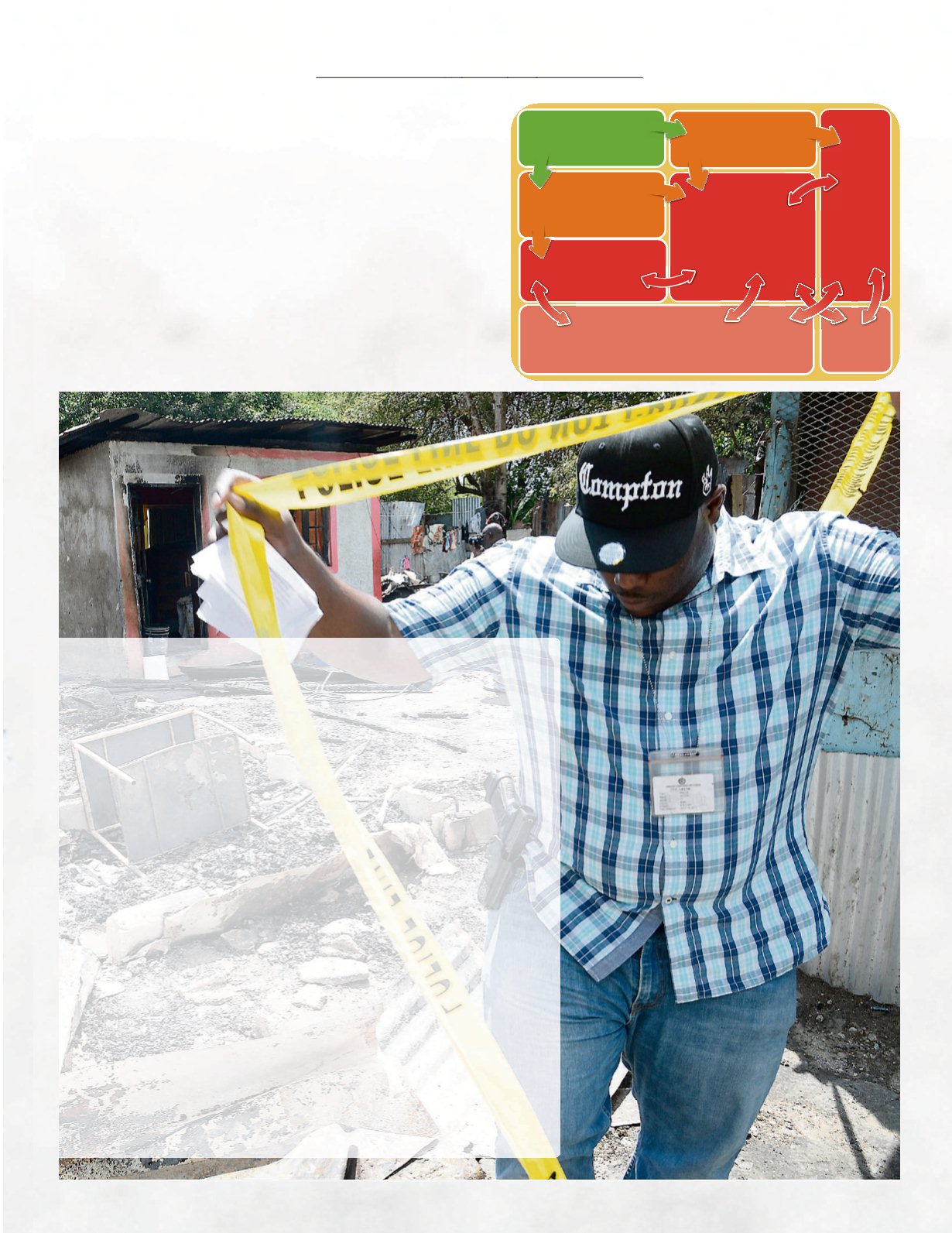
FILE
A police officer secures
the crime scene after
gunmen shot seven per-
sons, killing five –
including three children –
and set their home ablaze
at Africa settlement in
March Pen community in
Spanish Town on
Sunday, October 9.
‘WE PASS ON THE
GENE TO EFFECT WAR’
PUBLISHED: JANUARY 26, 2017