



 7 / 24

THE PRIMARY prob-
lems of social violence in
Jamaica are gangs,
organised crime, and
domestic conflict.
Jamaica suffers
immensely from the
feuds that are created
from gangs and organ-
ised crime, but these are
fed by problems within
our families that lead to
high incidence of domes-
tic violence, especially
against children. Once all
of these factors remain
active and stable,
Jamaica’s homicide rate
will keep security offi-
cers in necessary war-
readiness mode.
In violence studies, it
has been popularised by
Doyle and Sambanis
(2000) that a civil war
meets the criteria of being
armed conflict in which
1,000 or more combatants
are killed; the war repre-
sents a challenge to the
sovereignty of a recog-
nised state; occurs within
the recognised boundary
of that state; involves the
state as one of the princi-
pal combatants; and the
‘rebels’ are able to mount
an organised military
opposition to the state and
to inflict significant casu-
alties on the state.
While I accept their use
of the 1,000 combatant
deaths benchmark on the
grounds of their immediate
field context, I cannot help
but notice that it ignores
country size. A thousand
Kittitians dying out of a
population of 54,000 is not
comparable to a thousand
dying in Mexico with over
120 million people.
Careful examination of the
data on the most violent
countries show that in
order for countries to meet
most or all of the criteria
outlined for a civil war,
they would need to have a
homicide rate of at least 30
per 100,000. I have repeat-
edly suggested using this
benchmark.
GARRRISONS FOR
GUARANTEED VOTES
Prior to independence,
Jamaica had a homicide
rate that was comparable
with the world’s average.
However, Jamaica is not
one of the countries that
did well with the transfer
of power upon achieving
independence. With inde-
pendence came enormous
social and economic
demands from the popula-
tion, and violent competi-
tion for power among
politicians. This led to the
political wars of the 1970s
and 1980s. Garrisons were
constructed in order for
politicians to guarantee
votes, and the youth
quickly organised them-
selves into gangs to effect
war to benefit from the
spoils of war and partisan
contracts. Between the
1960s and the early 1980s,
murders increased almost
fourfold. Between the
elections of 1980 and
1989, there was some
degree of stability due to
the absence of a contested
election; but the figures
shot up again after the
1989 general election and
peaked in 2005 when
Jamaica ranked number
one in the world.
In this year, the homi-
cide rate was 64 per
100,000. In this period,
Jamaica also became a
primary trans-shipment
point for Colombian
cocaine and that fuelled
the murders among gangs
across party lines and
within politically aligned
gangs – but also worked
to reduce the core of the
political violence, given
politics was no longer the
main source of guns and
money.
(See Figure 1)
Since then, Jamaica has
been identified as a country
of turf/gang feuds expected
to account for an average of
60 per cent of the country’s
murders. Let me use data
from the National
Intelligence Bureau to illus-
trate the extent to which
young men are focused on
killing each other in feuds. In
2005, the country’s homicide
was 64 per 100,000. This
was, however, 120 per
100,000 for males across
Jamaica. It should come as
no surprise that the murder
rate for males was 200 per
100,000 for the Kingston
Metropolitan Region
(KMR), which comprises
Kingston, urban StAndrew,
Portmore and Spanish Town.
For males of the combatant
age (15-34 years) for the
KMR, the 2005 homicide
rate was 340/100,000 – and
moved to 405 when police
killings are added.
WAR-READINESS
MODE IN JAMAICA
Murder rate in Jamaica
1960-2015 broken into
12-year periods
1960-1971 1972-1983 1984-1995 1996-2007 2008-present
5.8
20.1
23.8
45.8
47.9
FIGURE 1
FILE
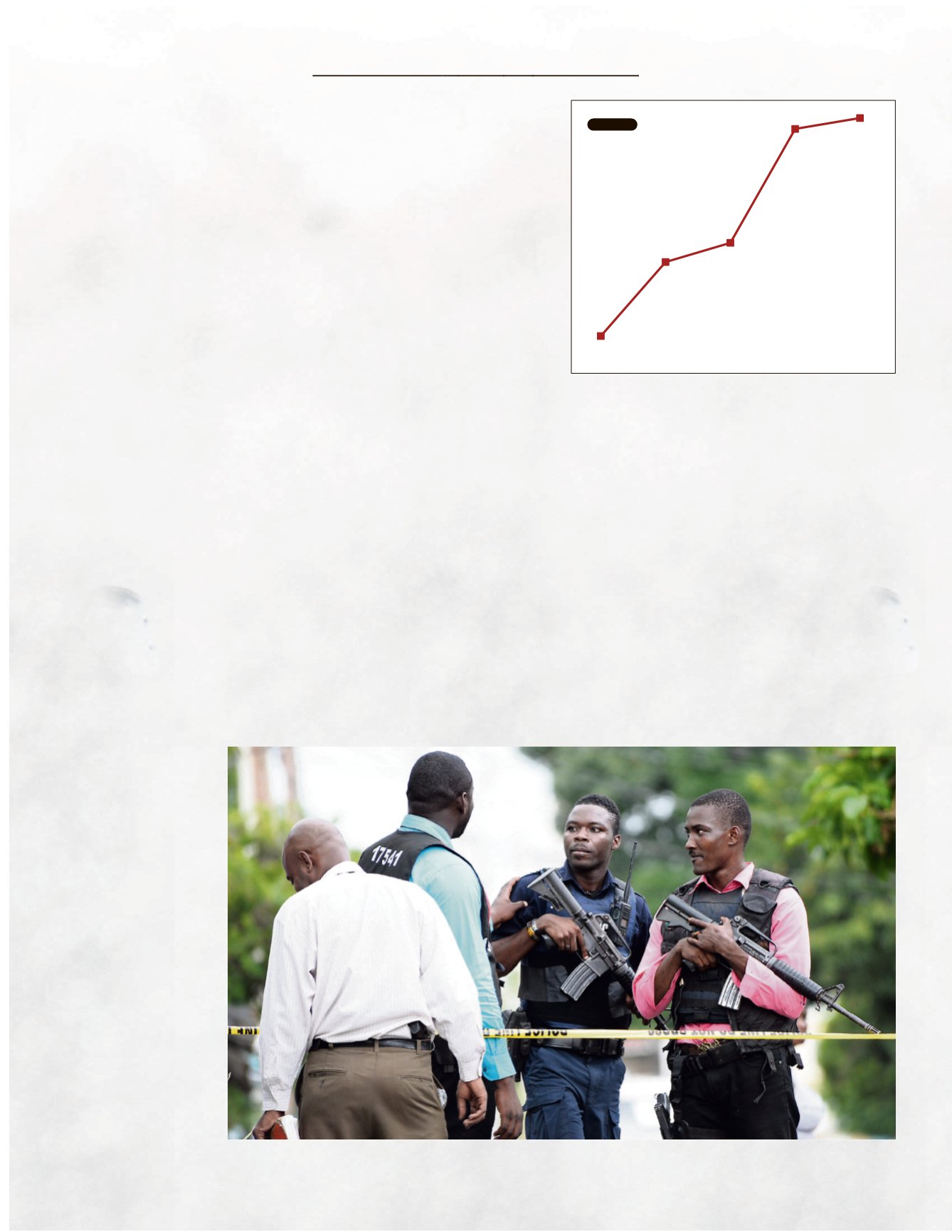
Police on the crime scene on Wellington Street, where a shooting took place last year.
PUBLISHED: JANUARY 25, 2017